Is your organisation meeting Australia’s Cybersecurity Baseline?
Every unpatched application, every over-privileged account, and every unprotected admin credential is a gap that adversaries actively hunt for. Australian organisations, especially small and mid-market businesses, are increasingly in the crosshairs.
The consequences of inaction are real: financial loss, regulatory exposure, irreparable reputational damage, and operational downtime. The Essential Eight framework exists specifically to close the gaps that matter most. The question is not whether your organisation needs it. It's how far behind you already are.

Financial and legal exposure.
A single ransomware incident can cost hundreds of thousands in recovery, downtime, and regulatory fines, costs that dwarf any investment in prevention.

Credential and identity compromise.
Most breaches begin with stolen credentials. Without MFA and privilege controls, a compromised password can grant an attacker total network access.

Compliance and audit risk.
Government and enterprise customers increasingly require suppliers to demonstrate Essential Eight compliance. Failing to meet baseline standards can cost you contracts.

Irreversible data loss.
Without properly tested backups and an offline copy strategy, ransomware attacks can permanently destroy years of business data and operational records.
The ACSC Essential Eight Framework
Developed by the Australian Signals Directorate, the Essential Eight targets the most impactful attack vectors. All eight controls together form a layered defence that dramatically reduces your attack surface.

Application Control
Prevent unapproved or malicious software from executing across your environment; only whitelisted applications are permitted to run.

Patch Applications
Keep browsers, Office, PDF readers and internet-facing software patched to eliminate exploitable vulnerabilities before attackers can leverage them

Configure Microsoft Office Macros
Disable or restrict macros from the internet, a common vector for malware delivery, while enabling legitimate macros from trusted sources.

User Application Hardening
Block browser-based threats like Flash, Java applets, and ads, common delivery mechanisms for drive-by malware that require no user interaction to install.

Restrict Administrative Privileges
Limit admin access to only those who require it, and separate privileged accounts from daily-use accounts to contain the blast radius of any compromise.

Patch Operating Systems
Keep servers and workstations up to date with security patches. Unpatched OS vulnerabilities remain one of the most frequently exploited entry points.

Multi-Factor Authentication (MFA)
Require a second factor for all remote access and privileged accounts, so that credential theft alone is insufficient to gain entry to your systems.

Regular Backups
Maintain tested, offline and off-site backups with defined recovery time and recovery point objectives, ensuring you can recover cleanly from any incident.
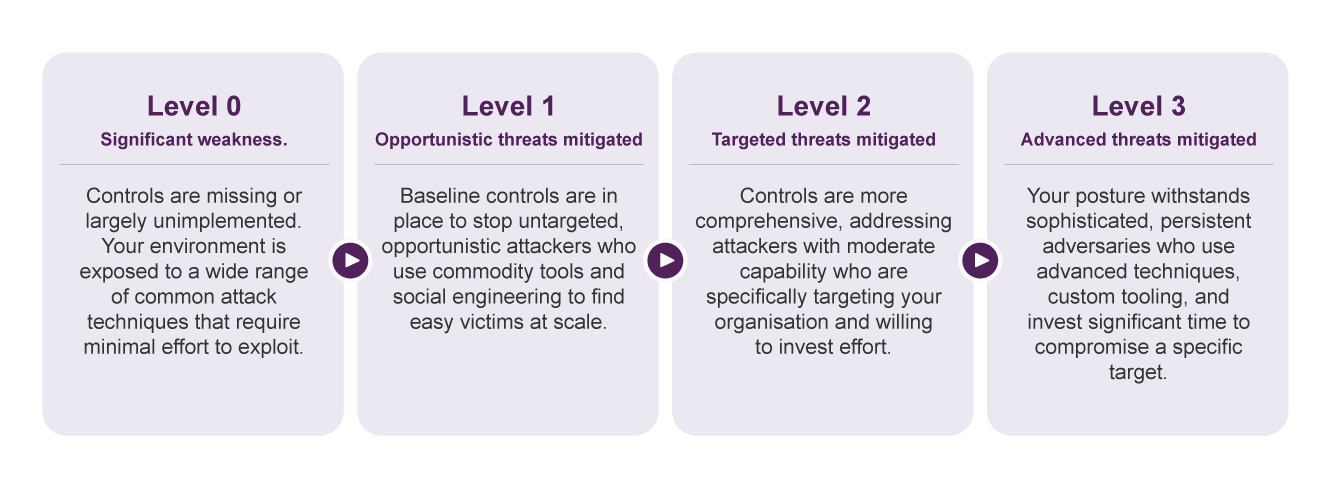
The Essential Eight Maturity Levels:
Where do you stand?
The ACSC's maturity model grades your implementation against the sophistication of likely attackers.
Most organisations target Level 2 as their baseline; high-value targets should aim for Level 3.
Our Essential Eight Assessment Process
Our assessment is designed to be low-burden for your team and high-value in its output.
We do the heavy lifting so you can get a clear picture of where you stand and exactly what to do next.

Scoping
We will conduct a series of workshops to understand your current environment and business goals and confirm the right engagement.

Discovery
Our consultants will assess your security controls across all eight strategies at the individual requirement level, benchmarked against the updated ASD model. Conducted remotely or on-site, with minimal lift from your team.

Analysis
We will provide a clear report showing your current maturity level, the gaps, and what your existing Microsoft tools already cover, so remediation is targeted, not speculative. Written for both your technical team and your leadership.

Reporting
We will walk your team through the findings and hand over a prioritised remediation roadmap, sequenced by risk, mapped to your Microsoft environment, and ready to act on.
Why Essential Eight compliance matters now more than ever

Reduce your actual attack surface.
Rather than reacting to threats, Essential Eight gives you a structured, prioritised method for eliminating the vulnerabilities attackers most commonly exploit, closing gaps before they're found.

Contain damage and recover fast.
When incidents do occur, a high maturity posture dramatically limits lateral movement and data loss, cutting recovery time and the financial impact of any breach.

Speak to your board with confidence.
The maturity model provides a clear, quantifiable benchmark for reporting security posture to leadership, turning an abstract risk into a trackable, improvable score.

Smart investment, measurable ROI.
The Essential Eight is specifically designed to deliver the highest risk reduction per dollar spent. Leveraging your existing Microsoft licensing, many controls cost less than you expect.
“Both the IT operating environment standardisation and the successful achievement of
Essential Eight Maturity Level 2 have proven a huge win for us as an organisation.
We now have a more efficient and effective, centrally managed IT services delivery capability
and have significantly improved our cyber security posture”,
Governance Institute of Australia
Your Microsoft Security Partner for Essential Eight in Australia
Professional Advantage has almost 40 years of experience delivering Microsoft solutions and services across Australia. We are one of a handful of multi-skilled Microsoft Solutions Partners and Tier 1 CSPs operating in Sydney, Melbourne, Brisbane, and Perth, with four Microsoft Solutions Partner designations and a consistent track record of helping mid-market and enterprise organisations achieve and maintain their Essential Eight targets.
35+
years of solid experience in the IT industry
9.7
years average client retention
90+
consistently high net promoter score
1000+
Australian organisations supported across all industries
Professional Advantage is a Microsoft Solutions Partner for Security, Modern Work, Data and AI, and Business Applications.


Take the first step. Know your gaps before attackers do.
Complete the form below or contact us on 1800 126 499 to speak with one of our security consultants. Contact us today to schedule your Essential Eight assessment.
Frequently Asked Questions
What is Essential Eight, and how does it protect my business?
Essential Eight is a baseline security strategy recommended by the Australian Signals Directorate (ASD) to protect businesses against cyber threats. It is composed of eight strategies:
- Application Control
prevents execution of malicious programs from automatically running by having a set of pre-approved apps. - Patch Applications
helps mitigate vulnerabilities on apps that need patching. - Patch Operating System
allow you to mitigate vulnerabilities on operating systems that need patching. - Restriction of Administrative Privileges
review admin privileges on specific IT systems and provide necessary permissions only for those who need them. - Configure Microsoft Office Macros
review Office macros and current policies to prevent untrusted macros with malware from automatically running. - User Application Hardening
ensure that unauthorised applications such as Adobe Flash Player or Java applets will not be utilised in browsers that have been known to deliver malware. - Multi-Factor Authentication (MFA)
use a second factor such as a physical token or mobile device to authenticate user access. - Review Backups
ensure regular backups of data so you can get it back in case you suffer a cyber-attack.
When implemented correctly, these eight strategies can greatly help defend against common cyber threats. Understand further what the Essential Eight is, why it's important and its maturity levels in this video.
Who needs to comply with Essential Eight?
The Essential Eight is mandatory for all non-corporate Commonwealth entities under the Australian Government's Protective Security Policy Framework (PSPF).
For private sector organisations, it is not legislated, but it is increasingly expected. Evidence of Essential Eight compliance is now a common requirement in government and defence procurement processes, and organisations in regulated industries such as financial services, healthcare, and critical infrastructure are under growing pressure to adopt it as a baseline standard.
Even outside regulated sectors, the framework represents the ASD's best-practice recommendation for any Australian organisation running internet-connected systems.
What are the requirements for Essential Eight Maturity Level 2?
Maturity Level 2 is the target benchmark for most Australian organisations and the mandatory minimum for Commonwealth entities. Under the updated November 2023 model, reaching it requires:
- Phishing-resistant MFA for all users, including workstation login. Standard push notification or SMS-based MFA no longer qualifies.
- Critical vulnerabilities patched within 48 hours and internet-facing applications patched within two weeks.
- Application control with Microsoft's recommended application blocklist in place and rulesets reviewed annually.
- Both ASD and vendor hardening guidance applied to all systems, the more stringent requirement takes precedence where they conflict.
- Privileged access validated on first request and automatically disabled after 12 months if not revalidated.
- Centralised event logging across internet-facing infrastructure, with a documented and tested incident response plan.
- Immutable, regularly tested backups prioritised by business criticality.
If your organisation achieved Maturity Level 2 before the 2023 update, it is worth reassessing. The requirements have changed materially, particularly around MFA and privileged access governance.
How long does it take to implement Essential Eight?
It depends on your starting point, target maturity level, and the complexity of your environment, but here's a realistic guide:
- Gap Assessment: 2-4 weeks from scoping session to final report, for most mid-sized to enterprise organisations.
- Reaching Maturity Level 1: Typically 1-3 months, assuming Microsoft 365 is already in place and the primary work is configuration and policy deployment.
- Reaching Maturity Level 2: Typically 3-6 months, with the most time-intensive workstreams being phishing-resistant MFA rollout, privileged access governance, and centralised logging.
- Reaching Maturity Level 3: 6-12+ months, depending on the complexity of your environment and the degree of architectural change required (such as Secure Admin Workstation deployment).
The good news for Microsoft 365 and Azure customers is that much of the required capability already exists in your stack. In many cases, implementation is faster and less costly than organisations expect.
Not quite ready yet?
You might be interested in the resources below.

ASD Cyber Threat Report: What IT Leaders Need to Know
Read article →
Essential Eight Cybersecurity from the Server Room to the Boardroom
Watch on-demand webinar →
4 Cybersecurity Frameworks: Which one is right for your business?
Read article →
How to use the Microsoft Secure Score to improve my business’ security posture?
Read article →Explore More of Our Microsoft Security Services