
MICROSOFT FABRIC
Your data, unified. Finally.
Reduce data sprawl and duplicate datasets with Fabric OneLake, a single, governed data foundation for analytics and AI initiatives.
To gain an accurate view of business performance, often organisations need to bring together data from multiple systems. However, creating a unified analytics environment can be challenging, and ensuring everyone works from the same information can be difficult. OneLake helps address these challenges by bringing business data together in a single, governed location, enabling teams to work from the same trusted source for analytics. For organisations already using Power BI, OneLake extends the value of your investment by reducing data duplication and movement, increasing consistency across reports, and enabling more timely insights. For those exploring Microsoft Fabric, OneLake provides a modern data foundation for reporting, analytics, and future AI initiatives.
From Fragmented Data to Unified Analytics
Business outcomes backed by a Modern Data Foundation
Different stakeholders often experience the impact of fragmented data in different ways. Business users need trusted insights, while technical teams need a scalable and governed data environment. OneLake helps address both.
Looking to unify your data into a single source of truth?
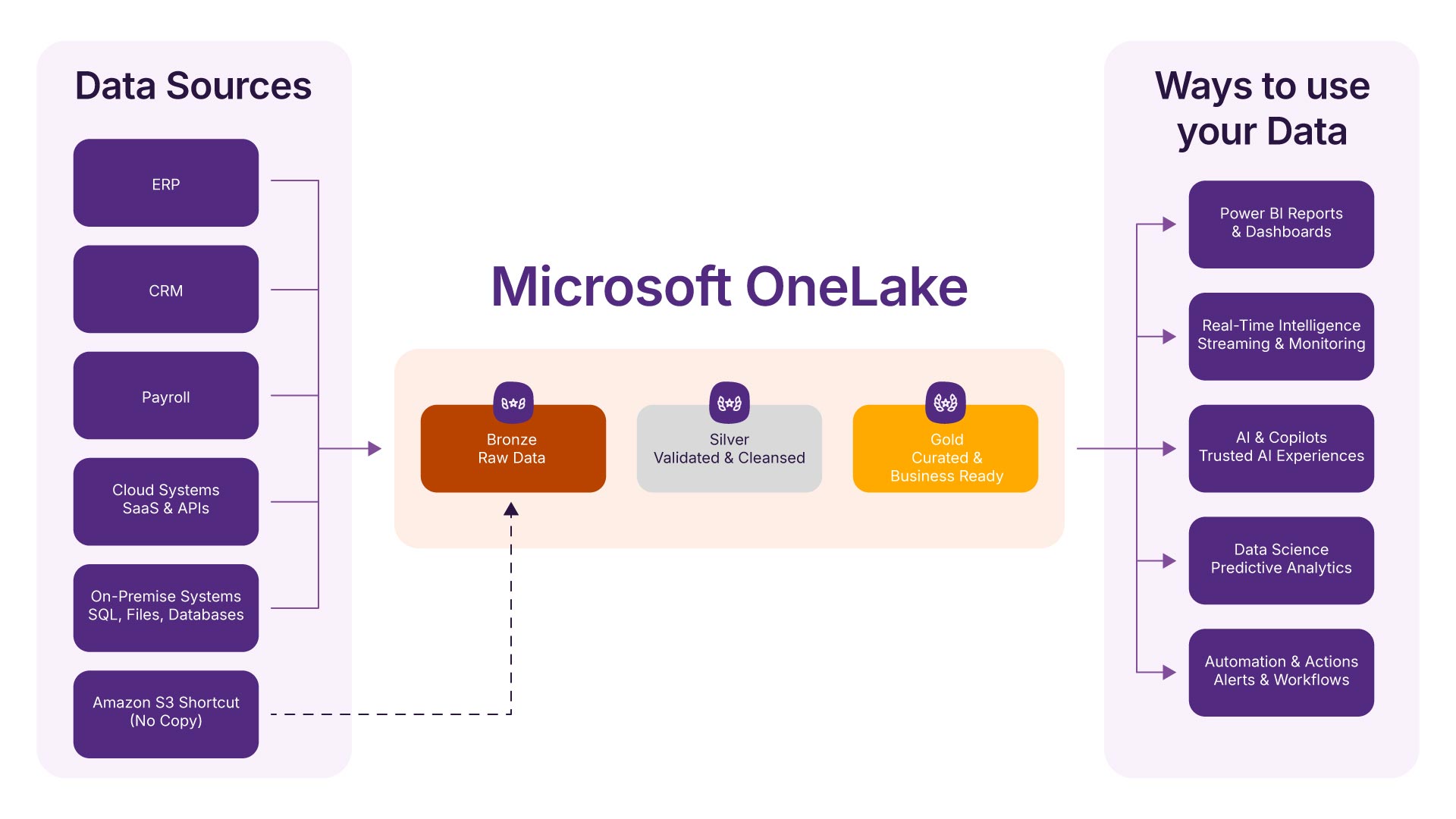
One Place for Every Fabric Experience. Multiple Ways to Use Your Data.
OneLake provides a single location where data can be stored and accessed across Microsoft Fabric. Whether you're building reports, preparing data, analysing real-time events or enabling AI-powered experiences, every team works from the same trusted foundation.

Built on Open Standards
OneLake stores data in the open Delta Parquet format, which is designed for high-performance analytics and is supported by a wide range of data platforms and tools. This helps ensure your data remains accessible and portable, while Azure Data Lake infrastructure ensures the scalability and reliability needed for enterprise workloads.
Turn Raw Data into Trusted Insights
Bringing data together is only the first step. To deliver trusted analytics, data also needs to be organised, validated, and prepared for business use. OneLake supports a structured approach to managing data, often referred to as a Medallion Architecture, that helps transform raw data into trusted, business-ready information for reporting, analytics, and AI.
Our Approach:
A successful OneLake implementation starts with the business outcomes
A successful OneLake implementation starts with understanding your business and your objectives, not with technology. We work with stakeholders across the business to understand reporting requirements, current challenges, governance needs and future initiatives. This approach ensures that the OneLake architecture is designed to support business objectives from day one.
With a clear understanding of your business requirements, we design a Fabric and OneLake architecture that supports trusted reporting, analytics, and future AI initiatives. This includes defining how data will be organised across business domains and teams, and how it will be governed and made available to analysts and business users using best-practice frameworks such as the Medallion Architecture.
Once the architecture has been defined, we connect and centralise data sources, establishing the processes required to transform raw data into trusted, business-ready information. This includes building data pipelines and implementing data quality and governance controls. This stage also includes testing, validation, and user acceptance to ensure data aligns with business expectations.
Once a trusted data foundation is established, the focus shifts to enabling teams to consume and use it effectively. Whether through Power BI reports, Copilots, Fabric Agents or future Fabric workloads, OneLake provides a shared data foundation that can support a wide range of business initiatives. As business requirements evolve, we help extend and optimise the Fabric and OneLake architecture to meet new reporting and analytics requirements.
Before you implement OneLake:
Key Considerations for Building a Unified Data Foundation
A successful OneLake implementation is about more than technology. It also requires team alignment, governance and operational processes to support long-term success. Download our practical considerations guide to explore key business, governance, data and architectural factors that can influence the success of your unified data foundation.
Frequently Asked Questions - Microsoft Fabric OneLake FAQs
OneLake is a single, central location for storing and managing business data, enabling consistent use across reporting, analytics, AI, and other Fabric workloads. It is the data foundation for Microsoft Fabric, unifying and securing data, making it ready for discovery, all in one place.
One per tenant.
Every Microsoft Fabric tenant automatically includes a single OneLake. You cannot create additional OneLake instances within that tenant. Instead, data is organised within OneLake using workspaces, domains, lakehouses, databases and other Fabric items.
Organisations with regional data residency requirements can deploy Fabric capacities in different geographic regions using Multi-Geo, allowing data to remain within designated locations while still part of a unified OneLake architecture.
Databases and OneLake solve different problems.
OneLake is the shared storage layer, within a central location where enterprise data is stored and shared across Fabric workloads. Data is unified from different business systems into OneLake, prepared and secured, ready for use for reporting and analytics.
A Fabric Database is a Fabric storage item intended for transactional or operational application data within the Fabric ecosystem. It is suitable for specific use cases where app-style operational or relational transaction workloads are required.
OneLake Shortcuts are one of the most powerful features of Microsoft Fabric. If your data is already stored in Azure Data Lake Storage (ADLS), Amazon S3, Google Cloud Storage, or another supported location, it does not need to be copied into OneLake. A shortcut creates a reference to the source data, making it available across Microsoft Fabric experiences such as Power BI and Data Science without creating duplicate copies.
Talk to a data specialist
Ready to consolidate your data?
Book a time with one of our data specialists to find out how OneLake can help your organisation achieve a single source of truth for your reporting and analytics
Prefer to call? Reach us on 1800 126 499.
Your information will never be shared or sold to a 3rd party. Please read our privacy policy.